





Summary: This guide provides essential information for selecting the most suitable primary stone crusher for your operation. Different crusher types are analyzed, from traditional jaw and gyratory crushers to impact crushers...
What Is a Primary Crusher?
Primary crushing is the first step of most rock crushing processes within mining and other industrial sectors. At this stage, large raw materials such as ores, minerals, quarry rocks and construction debris are reduced in size to outputs suitable for further downstream processing. The type of primary crusher selected has a significant impact on production efficiency, costs and overall process optimization.
This article explores the primary crusher options available and factors to consider when making the choice to best suit individual applications. With a clear understanding of equipment specifications and project needs, the right selection lays the foundation for successful project execution.
Types of Primary Stone Crushers
Each has distinct characteristics making one better suited for certain applications than others. Understanding their workings, capabilities and limitations enables selection of the most appropriate unit.
The three main crushers considered for primary crushing:
- Jaw Crusher
- Gyratory Crusher
- Impact Crushers
1. Jaw Crusher
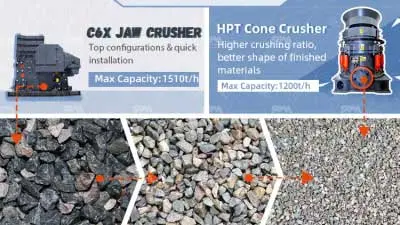
One of the most widely used primary crushers is the jaw crusher. Jaw crusher is robust, reliable, and capable of handling large feed sizes, making them a popular choice for primary crushing applications. They utilize a fixed and a movable jaw to gradually reduce the material size through a compressive action. Jaw crushers are well-suited for hard, abrasive, and moderately soft materials, and their simple design and low maintenance requirements contribute to their widespread adoption.

Structure: Jaw crushers typically consist of a stationary jaw and a moving jaw. The latter exerts pressure on the trapped material in a crushing motion against the fixed jaw.
Feed Size: Jaw crushers can handle feed sizes up to 1200 mm, depending on the model. Larger feed openings lead to higher throughput capacities.
Applications: Suitable for most rock and mineral types, with a maximum compressive strength of 320 MPa. Widely utilized initially to break larger run-of-mine rock for further secondary classification.
Operation: Jaw crushers operate in an intermittent motion and require uniform feeding to maintain optimal performance and avoid clogging. Best suited for intermittent crushing and low-abrasion materials.
Throughput: Production capacities range from 50-600 tph. Single toggle models have a lower capacity than double toggle varieties.
Advantages: Robust, reliable construction. Low capital and maintenance costs. Can operate profitably at lower production rates than gyratories and impactors.
Limitations: Unsuitable for sticky, mud-like feeds prone to jamming. Produces more fines than other crusher types due to squeezing action. Higher wear on moving parts demands frequent replacement.
2. Gyratory Crusher
Equipped with an oscillating crushing head inside a hollow shell on an eccentric axis, gyratory crusher provides a continuous crushing action. They are suitable for reducing large ores and rocks from 1000mm to below 50mm. Gyratory crusher can accept harder and more abrasive feed than jaw crushers while operating continuously. Higher-capacity gyratory crushers deliver a throughput of 500–9000 tph. These larger machines require permanent foundations.

Structure: Consisting of a cylindrically mounted cone lined with wear parts, a gyratory crusher has an oscillating shaft fitting within the main frame. It crushes simultaneously from top and bottom using compression.
Feed Size: Larger gyratory crushers have openings up to 1600 mm and can crush rocks with a diameter of up to 1370 mm.
Applications: Suitable for semi-abrasive to abrasive rocks with compressive strengths under 600 MPa due to continuous operability with fewer fines produced. Commonly utilized for primary limestone crushing.
Operation: Gyratory crusher function continuously, are less prone to clogging and facilitate automated operation. They accept higher moisture content than comparable jaw units.
Throughput: Units process 500-9000 tph depending on size, feeding chutes, grinding chamber capacities and motor power.
Advantages: Continuous operation prevents backups. Handles variable feed sizes well. Produces cubical products enabling uniform blending downstream. Fewer fines ensure classification efficiency.
Limitations: High capital costs. Complex maintenance requiring specialized skills. Less flexible for low production operations. Over-designed for some small-scale applications.
3. Impact Crusher
In recent years, impact crusher have gained increasing attention as primary crushers, particularly in applications where a more cubical and uniform product shape is required. Impact crushers use the kinetic energy of rapidly rotating hammers or blow bars to fracture the material upon impact. They are effective in reducing softer, less abrasive materials and can produce a more desirable end product gradation for certain applications.

Structure: Impact crusher uses high-speed rotating hammers or other impacting surfaces to fracture raw material against stationary impact plates inside the crusher chamber.
Feed Size: Main impact crushers suit feed sizes up to 300 mm, while smaller variants accept 150 mm feeds. Larger sizes and capacities available with tertiary and quaternary crushers.
Applications: Ideal for soft to medium-hard rocks with lower strength like limestone, gypsum, shale and clay. Also suitable for abrasive, non-abrasive and dry/wet materials.
Operation: Multi-impact crushing enables efficient one-stage processing, reducing energy consumption versus two-stage crushing. Adjustable rotor speed controls product gradation.
Throughput: Typical crushing capacities vary between 50-500 tph for different size crushers. Higher capacities are possible with increasingly larger models.
Advantages: Low capital cost. Simple structure with fewer components versus gyratories and jaw crushers. Adjustable product size. Highly portable with minimal civil works required.
Limitations: Their lower maximum feed size limits them to operation mainly as secondary and tertiary crushers for sizing reduced primary crushing products. Higher wear part costs than compression crushers due to impact duty.
Factors in Primary Crusher Selection
When assessing suitable crushers, operators consider both technical specifications and project parameters:
- Material Type - Crushing properties like hardness, abrasiveness, moisture content influence suitable crusher types.
- Maximum Feed Size - Largest single feed piece acceptable by crusher opening size.
- Required Throughput - Total crushing capacity needed based on planned production levels.
- Product Size - Finished particle gradation required for subsequent processing stages.
- Capital & Operating Costs - Initial investment, energy, maintenance, wear part replacement expenses.
- Location - Space constraints, accessibility for delivery, service in remote areas affecting choices.
- Portability - Mobile, semi-mobile or stationary selection impacts civil foundation requirements.
- Flexibility - Variable primary crusher allows processing multiple materials or gradations.
- Secondary Processing - Crusher output best matches grinding/classification equipment efficiency.
With all parameters evaluated, accurate primary crusher selection supports cost effectiveness over equipment lifetime through:
- Maximized production throughput matching designed rates
- Optimal energy efficiency with minimal wasted motion
- Minimal equipment breakdowns from suitable material handling
- Uniform product sizes permitting consistent downstream processing
- Lower total cost of ownership compared with over‑specified or under‑specified units.
In summary, choosing the right primary crusher is crucial for your project's success. Each crusher type has unique advantages and applications suited to specific material and throughput requirements.
SBM provides high-quality crushing equipment and solutions, ensuring efficient processing and smooth project execution with full support for all your needs. Our experienced team can assist with crusher selection recommendations based on technical specifications and your operational parameters. We also offer installation guidance, training, and comprehensive after-sales services to optimize your crushing circuit performance.
By selecting the most appropriate primary crusher matched to your individual project characteristics, SBM aims to maximize your productivity while minimizing costs throughout the asset lifecycle. Please feel free to contact us if you require any consultation or assistance in crushing equipment selection and process optimization.


 Get Solution
 Send Message