




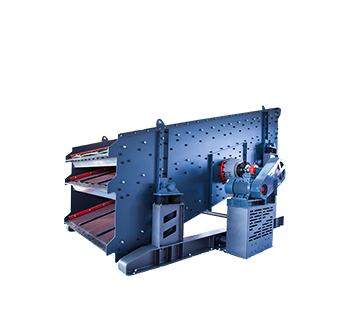
Summary: As an important piece of equipment, the screening efficiency of the vibrating screen will directly affect the finished product quality and investment cost....
Many mine owners are facing problems such as the vibrating screen failing to reach the expected processing capacity or low screening efficiency during production. As an important piece of equipment, the screening efficiency of the vibrating screen will directly affect the finished product quality and investment cost.
Generally, the screening efficiency of a vibrating screen is related to several factors such as material nature, equipment structure and various performance parameters. Apart from the basic requirements of choosing vibrating screen (material nature and equipment structure), today we mainly analyze 5 important performance parameters which relate to the efficiency of vibrating screen: These include amplitude, vibration frequency, vibration direction angle, screen surface inclination angle and projection angle.
Amplitude of vibrating screen
In general, the larger the size of the vibrating screen, the larger the amplitude selected. That’s because a larger amplitude means less screen hole plugging, which is more conducive to ore screening stratification and helps achieve better screening capacity. But it should be noted that if the amplitude of the vibrating screen is too large, the strong vibration may damage the equipment itself.

The vibration screen amplitude is usually determined by the particle and nature of ore. For example, when the ore particles are small and moist with a certain viscosity, we need to use vibrating screen with low frequency and large amplitude.
In addition, corresponding amplitude and frequency should also be adopted for different screening stages. For example, screening operation before selection generally use vibrating equipment with low frequency and large amplitude, and vibrating screen with high frequency and small amplitude are used in dewatering and desorption operations.
Vibration frequency
The vibration frequency has a direct effect on the run-out state of ore particles on the screen. Vibration frequency that is too high or too low is not beneficial to the screening efficiency. Studies have shown that no matter what kind of screening is carried out on the vibrating screen, it is an ideal option for vibration frequency to maintain between 850 -1000 times a minute.

Under the same vibration intensity, if the frequency of vibrating screen is too low, the weight of the eccentric block of the vibrator will increase, which is not economical. On the contrary, higher frequency can greatly affect the speed of ore; this will decrease the processing power.
Therefore, vibration frequency can't be randomly adjusted. In order to make the vibrating screen achieve ideal performance, users should adjust the vibration frequency according to the actual situation.
Screen surface inclination angle
The screen surface inclination angle refers to the angle between the screen surface and the horizontal plane, the magnitude of the angle is related to the vibrating screen processing capacity and screening efficiency. When the screen surface inclination angle increases, the movement speed of ore particles on the screen surface will be faster, and the processing capacity will be increased, but at the same time, the ore particles will stay on the screen surface for a correspondingly shorter time, thus affecting the screening efficiency, and vice versa.

Vibration direction angle
The vibration direction angle refers to the angle between the screen motion direction and the screen surface. When users decide to adjust the vibration direction angle, they should consider the nature of the ore being sifted firstly. For ores with high density, small particle size or easy breakage, a vibrating screen with a large vibration direction angle should be used. For ore with high water content, strong viscosity or wear resistance, the vibration direction angle should be adjusted to small.

In actual production, most linear vibrating screens adopt vibration direction angles of 30°, 45° and 60°. That‘s because this kind of angle can not only adapt to various screening performance, but also obtain the best moving speed and screening efficiency.
Projectile angle of vibrating Screen
According to the screening theory and practice, the magnitude and strength of the projectile angle of the vibrating screen have a direct influence on the screening ore. When the ore projectile intensity increases, the inertia force is also increased; thus the ore can be thrown higher, which is more conducive to the ore handling. However, too much projectile intensity will inevitably affect the screen box, making it premature damage. Therefore, users should consider the strength of the vibrating screen box structure to determine the projection angle.

It is inevitable that there will be some differences between different types of vibrating screens in the actual processing. So we suggest that each mine owner should find the equipment manufacturer with overall qualification to buy the appropriate vibrating screen, and determine the parameter values according to the actual conditions, ensuring to obtain the ideal screening efficiency of vibrating screen.


 Get Solution
 Send Message