





Summary: This article comprehensively analyzes why impact crushers are unsuitable for the medium and fine crushing stage of basalt crushing plant, and why cone crushers are the better choice — from the perspectives of basalt's physical properties, the crushing principles of impact crushers and cone crushers, and the standardized configuration of basalt crushing plant....
In a basalt crushing plant, the selection of medium and fine crushing equipment is one of the key decisions that affects the return on investment of the entire production line.
Impact crushers perform exceptionally well under soft rock conditions such as limestone, which may lead many investors to form an inertial cognition that impact crushers offer high cost-effectiveness and excellent product shape, making them the go-to choice for medium and fine crushing. However, applying this experience to basalt crushing is not entirely appropriate.
Ⅰ. Physical Properties of Basalt
To understand why impact crushers are unsuitable for basalt crushing, we first need to understand what kind of rock basalt is.
Basalt is a basic extrusive igneous rock formed when magma cools rapidly at or near the Earth's surface after a volcanic eruption. The rapid cooling results in fine-grained, dense mineral structures, giving basalt extremely high structural strength.
1. Mohs hardness of 5–7: This ranks among the higher hardness levels of common rocks. For crushers that rely on metal components to apply direct force, the harder the material, the greater the damage to those components.
2. Compressive strength up to 300 MPa: This means the crusher must apply extremely high energy to fracture basalt. During this process, the energy acts not only on the rock but also reacts back onto the crusher itself.
3. Silica (SiO₂) content of 45%–52%: Silica is the primary component of quartz, which is one of the most abrasive minerals to metal in nature. With nearly half of its composition being silica, basalt is far more abrasive to equipment during crushing than most common materials.
In summary, basalt possesses both "high hardness" and "high abrasiveness," placing extreme demands on the impact resistance and wear resistance of crusher.

Ⅱ. Why Are Impact Crushers Unsuitable for Basalt Medium and Fine Crushing?
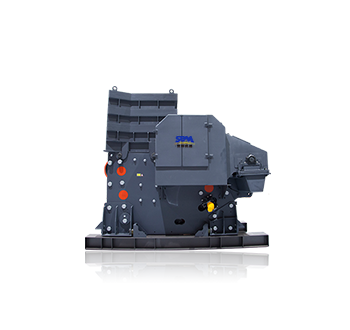
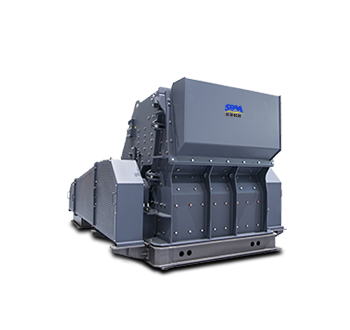
An impact crusher is a machine that uses impact energy to crush materials. Its core components include the rotor, blow bars, and impact plates. When material enters the blow bar's strike zone, it is shattered by the high-speed impact of the blow bars, then propelled upward against the impact plates above the rotor for secondary crushing, before bouncing back off the liner plates into the blow bar zone for re-crushing. This process repeats until the material is reduced to the target particle size.
This means that every crushing action is essentially a head-on high-speed collision between the blow bar and the material. This principle is highly efficient under soft rock conditions. When crushing low-hardness materials like limestone, impact crushers deliver a large crushing ratio, excellent product shape, and minimal blow bar wear. These advantages have made impact crushers widely used in soft rock crushing and typically the standard configuration for medium and fine crushing in soft rock production lines.
However, for hard rocks like basalt, impact crushers are not the optimal choice.

Ⅲ. Common Problems of Impact Crusher When Processing Basalt
When an impact crusher processes basalt, high efficiency can turn into high consumption.
1. High hardness leads to rapid blow bar wear
Soft rocks like limestone fracture easily upon impact, and the impact energy is consumed in breaking the rock, with limited reaction force reaching the blow bars. Basalt, with compressive strength up to 300 MPa, does not fracture easily at the moment of impact, meaning each impact inflicts far greater damage to the blow bars than when processing soft rock.
2. High abrasiveness reduces wear part service life
Basalt contains 45%–52% silica. While not its only component, the microcrystalline quartz and glassy textures derived from it give the mineral extremely high abrasiveness. These quartz particles produce intense micro-cutting effects on the metal components of the impact crusher during impact. Over time, this accelerates wear on wear parts and shortens their service life.
3. Declining production efficiency affects capacity
Frequent blow bar replacement not only increases parts costs but also directly reduces production efficiency and impacts capacity. Each replacement requires shutdown, during which the entire production line cannot operate—downtime equates to capacity loss. Frequent shutdowns may also increase the probability of failures in upstream and downstream equipment.
In summary, the problem with using impact crushers for basalt crushing goes beyond simple wear, it is a fundamental mismatch at the level of physical principles.

IV. Why Are Cone Crushers More Suitable for Basalt Medium and Fine Crushing?
This is not to say impact crushers are entirely inapplicable in basalt crushing. Rather, given the physical properties of basalt, cone crushers are the more recommended choice in practical engineering.
Here is why:
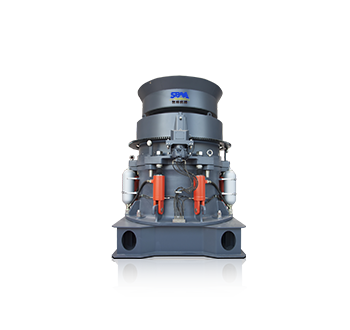
Cone crushers employ the lamination crushing principle. Unlike the impact crusher's mechanism of direct metal-to-rock collision, the cone crusher's crushing process occurs primarily between the materials themselves. After entering the crushing chamber, material is compressed between the mantle (moving cone) and the concave (fixed cone), forming a material layer. Most of the crushing action is accomplished through inter-particle compression, the metal liner plates bear only compressive forces, not high-speed impact.
This difference in principle directly determines that under basalt crushing conditions, cone crusher wear parts last far longer than those of impact crushers. Maintenance intervals are significantly extended, ensuring the production line can operate continuously, stably, and efficiently.

V. Standardized Process Configuration for Basalt Crushing Plant
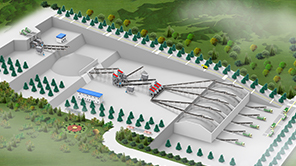
Based on the physical properties of basalt, a standard basalt crushing plant is typically configured as follows:
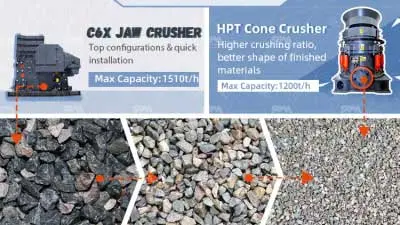
1. Primary crushing: SBM C6X Jaw Crusher. Driven by an electric motor via belts and pulleys, the eccentric shaft causes the movable jaw to swing back and forth and up and down to compress and crush material. Suitable for primary crushing of rocks of all hardness levels.
2. Medium and fine crushing: SBM HPT/HST Cone Crusher — the core equipment for basalt medium and fine crushing. The lamination crushing principle matches basalt's high-hardness, high-abrasiveness characteristics. Its unique structure provides stronger load-bearing capacity and can sustain powerful crushing force to handle basalt's high compressive strength.
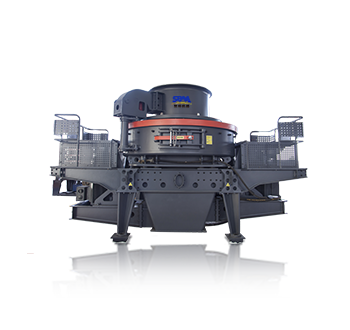
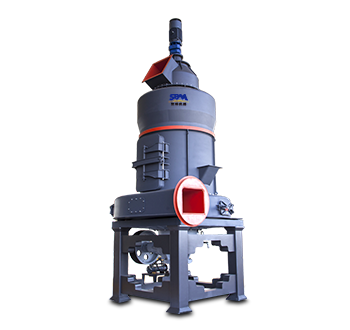
3. Shaping / Sand making: SBM VSI6X Sand Maker. Employing the "rock-on-rock" principle, material is propelled and impacts either the material layer it forms or other particles, avoiding direct contact with metal components. This reduces equipment wear and is well-suited for hard, highly abrasive materials such as basalt and granite. Aggregates feature excellent particle shape with low flakiness content.
For basalt crushing applications, a rational production line configuration (the powerful crushing force of the SBM jaw crusher, the lamination crushing of the cone crusher, and the rock-on-rock principle of the sand maker) ensures that each piece of equipment operates stably under conditions that match its working principle with the material's characteristics.
Learn more about crushers details: HPT Cone Crusher | C6X Jaw Crusher | VSI6X Sand Maker | CI5X Impact Crusher

VI. Conclusion
Why is the impact crusher not recommended for basalt medium and fine crushing, while the cone crusher is more suitable? The root cause lies not in equipment quality but in the crushing principle and material characteristics. When selecting equipment, customers should comprehensively consider production requirements, choosing the right and rational equipment can achieve twice the result with half the effort.
If you are planning a basalt crushing plant, feel free to consult SBM for a customized solution.


 Get Solution
 Send Message