





Summary: A comprehensive guide covering copper ore types, global reserves and production data, copper ore processing plant construction workflow, common beneficiation techniques, and post-beneficiation value realization for efficient metal production....
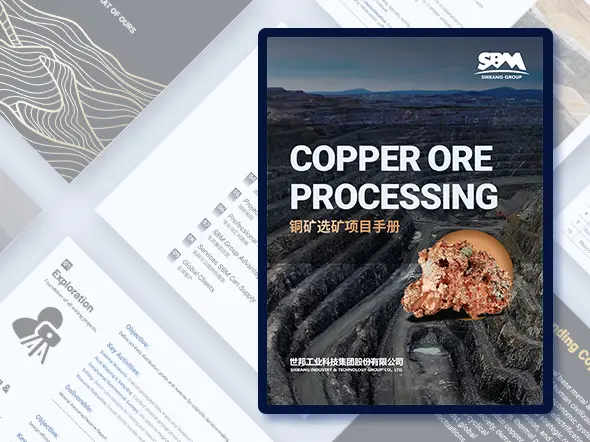
Copper Ore Beneficiation Process Handbook
This guide outlines the comprehensive process of copper ore beneficiation, from understanding copper minerals to plant construction and value realization.
The document highlights the complete project workflow—exploration, planning, construction, operation, and sales—along with tailings management and environmental compliance. The core section explains key processing methods: flotation for sulfide ores (most common), acid leaching for oxide ores, and auxiliary gravity separation.
Download the Full EbookWhat is the Copper?
Copper, as a globally critical base metal and industrial lifeline, has been a fundamental driver of human civilization since ancient times. In modern industrial and economic systems, copper serves not only as a core raw material for electrification, infrastructure, and manufacturing but also as a strategic resource for energy transition, technological innovation, and sustainable development.
Its exceptional conductivity, thermal properties, ductility, and corrosion resistance establish copper as the indispensable "King of Metals" in modern society, demonstrating both growth potential and anti-cyclical resilience amidst global economic fluctuations.

Types of Copper Ore
Copper exists in nature primarily as mineral compounds within various copper deposits, rarely appearing in native (elemental) form. Based on chemical composition and crystal structure, copper minerals can be categorized as follows:
Sulfide Ores
The most important copper ore type, accounting for over 80% of global copper production.
【Chalcopyrite (CuFeS2) 】
Appearance: Dull copper-red surface with iridescent tarnish
Mineralogical characteristics: Commonly intergrown with other metal sulfides, frequently associated with pyrrhotite.
【Bornite (Cu2FeS4)】
Appearance: Coppery-red surface with purple-blue tarnish
Mineralogical characteristics: High density, typically coexists with chalcopyrite; key indicator mineral in secondary enrichment zones.
【Chalcocite (Cu2S)】
Appearance: Dark lead-gray, soft texture with metallic luster, often occurring as sooty or massive aggregates
Mineralogical characteristics: Contains 79.9% copper, representing high-grade ore
【Covellite (CuS)】
Appearance: Indigo-blue color
Mineralogical characteristics: Typically found associated with other copper minerals

Oxide Ores
Formed through prolonged weathering and oxidation of primary sulfides, typically occurring in near-surface "oxide zones"
【Malachite (Cu2CO3(OH)2)】
Appearance: Vibrant emerald-green with banded patterns resembling peacock feathers, displaying silky or vitreous luster
Mineralogical characteristics: Most common copper oxide mineral, sometimes gem-quality. Forms through sulfide oxidation, serving as marker mineral for surface deposits
【Azurite (Cu3(CO3)2(OH)2)】
Appearance: Deep azure-blue with vitreous luster
Mineralogical characteristics: Occasionally used as gemstone material, typically found with malachite
【Chrysocolla】
Appearance: Green to blue-green
Mineralogical characteristics: Hydrous copper silicate with complex chemistry
【Cuprite (Cu2O) 】
Appearance: Red to dark red with metallic or adamantine luster
Mineralogical characteristics: Forms in deeper oxidation zones, product of secondary enrichment
【Tenorite (CuO) 】
Appearance: Gray-black, typically earthy; some varieties form more regular crystalline masses
Mineralogical characteristics: Common in oxidized copper deposits. Economically viable when sufficiently concentrated

Global Copper Distribution Overview
Global copper resources exhibit "high abundance, concentrated distribution". As of 2024, annual production reached~22.36 million tonnes with ~980 million tonnes reserves. Top 10 reserve holders control 75% of global reserves, with Chile alone possessing 19%; top three producers (Chile, Peru, DRC) contribute nearly half of global concentrate output. Africa emerges as new mining investment frontier due to mineral potential and favorable policies.
Global Copper Production & Reserves(USGS 2024, Unit: 10,000 tonnes)
| Rank | Country/ Region | 2023 Output | 2024 Output | Reserves |
|---|---|---|---|---|
| 1 | Chile | 550.7 (23.9%) | 530 (23.0%) | 19,000 (19%) |
| 2 | DR Congo | 284 (12.3%) | 330 (14.3%) | 3,100 (3.5%) |
| 3 | Peru | 273.6 (11.9%) | 260 (11.3%) | 7,700 (8.8%) |
| 4 | China | 180 (7.8%) | 180 (7.8%) | 2,600 (2.9%) |
| 5 | Indonesia | 110 (4.8%) | 110 (4.8%) | 2,400 (2.7%) |
| 6 | USA | 110 (4.8%) | 110 (4.8%) | 4,800 (5.5%) |
| 7 | Russia | 93 (4.0%) | 93 (4.0%) | 7,700 (8.8%) |
| 8 | Australia | 80 (3.5%) | 80 (3.5%) | 9,300 (10%) |
| 9 | Kazakhstan | 74 (3.2%) | 74 (3.2%) | 2,400 |
| 10 | Mexico | 70 (3.0%) | 70 (3.0%) | 5,300 (6.1%) |
African Copper Resources(WGC 2024, Unit: 10,000 tonnes)
| Rank | Country/ Region | 2024 Output | 2024 Reserves |
|---|---|---|---|
| 1 | DR Congo | 330 | 3,100 |
| 2 | Zambia | 74 | 2,100-3,500 |
| 3 | South Africa | ≈5 | 600 |
| 4 | Morocco | ≈3 | 500 |
| 5 | Namibia | ~2 | 60-100 |
| 6 | Botswana | ≈1.5 | 30-50 |
| 7 | Uganda | 1.5 | 20-30 |
| 8 | Mauritania | ~1 | 20-30 |
Copper Ore Processing Plant Construction Workflow
Plant construction is a complex, multidisciplinary project requiring significant capital and long execution cycles. It must follow rigorous scientific planning to ensure technical feasibility, economic viability, and ESG compliance.
1. Exploration
Foundation of all mining projects

Objective:
Define ore body distribution, grade, and reserves for scientific decision-making.
Key Activities:
- Desktop Research: Analyze geological data, maps, and literature to identify targets.
- Field Mapping & Sampling: Conduct detailed geological surveys.
- Geophysical/Geochemical Surveys: Use airborne magnetics/GPR to detect deposits.
- Drilling: Obtain core samples for testing and resource estimation.
- Resource Estimation: Create 2D/3D models estimating size, grade, and viability.
Key Deliverable:
Mineral Resource/Reserve Report.
2. Planning & Design
Translating exploration results into executable blueprints

Objective:
Design efficient, economical, and safe production lines.
Key Activities:
- Feasibility Studies: Assess economic and technical viability.
- Permitting & Financing: Secure environmental permits and funding.
- Mine Design: Plan infrastructure, access routes, mining methods (open-pit/underground). Extraction Design, Beneficiation Design and Taillings Design.
- Site Preparation: Construct access roads, facilities, and clear overburden.
Deliverable:
Feasibility Study Report, Mine Design
3. Construction
Transforming designs into physical infrastructure

Objective:
Ensure high-standard construction for rapid commissioning.
Key Activities:
Procurement: Global sourcing of crushers, ball mills, flotation cells, thickeners, filters, pumps, valves, automation systems.
Civil Works: Site leveling, roads, plant foundations, structural erection, starter dam for tailings storage facility (TSF).
Equipment Installation & Commissioning:
- Install and align crushing, grinding, separation, thickening, and filtration equipment per process flow.
- Install piping, electrical, and automation systems.
- Single-equipment testing: Verify individual unit operation.
- Load testing: Run with ore/water, gradually ramp up to design capacity and metrics.
Deliverable:
Commissioned plant with feed.
4. Operation & Maintenance
Steady-state production phase

Objective:
Safe, stable, efficient, low-cost operation
Key Activities:
Ore Mining & Haulage:
- Drilling & Blasting: Fragment rock for excavation.
- Loading & Hauling: Transport ore to plant via excavators/trucks.
Production: Run crushing, grinding, separation, thickening, filtration per design. Control key parameters (grind size, reagent dosage, flotation time, thickener density).
Maintenance: Regular inspections, servicing, and part replacement to minimize downtime.
Quality Control: Test feed, intermediates, and concentrate; adjust processes to meet specifications. Safety Management: Implement protocols, training, PPE, and emergency response systems.
5. Sales & Logistics
Value realization phase

Deliverable:
Achieved production targets.
Objective:
Fast, secure, low-cost value conversion.
Key Activities:
- Quality Assaying: Joint sampling/preparation/assay to determine final grade for settlement.
- Sales Agreement: Long-term contracts based on market prices.
- Concentrate Transport: Ship via truck/rail/sea with protective measures to preserve quality.
Deliverable:
Revenue realization
6. Tailings Management & ESG
Critical for environmental safety and social license

Objective:
Integrate safety, environmental responsibility, and social compliance.
Key Activities:
- Tailings Discharge: Tailings generated during production are transported via pipelines or other means to the Tailings Storage Facility (TSF) for storage.
- TSF Management: Continuously monitor dam stability, seepage, and water quality; simultaneously implement necessary environmental protection measures such as installing impermeable liners and constructing wastewater treatment facilities to prevent pollution.
- Tailings Comprehensive Utilization: Reprocess or otherwise comprehensively utilize tailings to recover valuable elements, or use them as construction materials, for backfilling mined-out areas, etc., thereby reducing tailings stockpiling, minimizing environmental impact, and maximizing resource utilization.
- Ecological Rehabilitation: Upon reaching design capacity, close and ecologically reclaim the TSF through vegetation restoration and landform recovery.
Common Copper Beneficiation Processes
Over 90% of industrial copper beneficiation cases follow these four mainstream routes, selected based on ore type, particle size, and economics.
Sulfide Ore Flotation (Most Common)
Applicability:
Dominant method for sulfide ores (chalcopyrite, bornite, chalcocite), covering >80% global production.
Principle:
Exploits differences in mineral surface properties using reagents to make target minerals hydrophobic for bubble attachment.
Process Flow:
- 1. Crush/grind ore to liberation size
- 2. Roughing: Initial Cu concentration
- 3. Cleaning: Upgrade concentrate grade
- 4. Scavenging: Recover remaining Cu from tails
- 5. Dewatering: Produce transportable concentrate

Oxide Ore Acid Leaching(Hydrometallurgy)
Applicability:Oxide ores (malachite, azurite), low-grade or clay-rich ores.
Principle:Dissolve copper using chemical solvents (e.g., dilute H2SO4), then recover from solution via heap/vat leaching.
Advantages:Handles low-grade ore, high purityDisadvantages: Long cycles, ore-specific
Process Flow:
- 1.Heap leaching: Irrigate stacked ore
- 2.Vat leaching: Agitate ore in tanks
- 3.Solution extraction: SX-EW process to produce cathode copper

Gravity Separation
Applicability: Mainly for coarse Cu minerals with significant density differences from gangue
Principle: Separates minerals by density under gravity/centrifugal forces
Advantages: Chemical-freeDisadvantages: Limited applicability,low recovery
Process Flow:
- 1.Equipment: Jigs, shaking tables, sluices
- 2.Feed preparation: crush → screen → gravity circuit.
- 3.Role in copper plants: auxiliary only.

Post-Beneficiation Value Realization
Core value realization process transforms low-grade ore into high-value products:
Product Upgrading:
Produce marketable Cu concentrate or cathode copper

Value Addition:
Recover byproduct Au, Ag, Mo, etc.

Market Conversion:
Sell concentrate to smelters or cathode to end-users

Profit Protection:
Optimize recovery rates, reduce costs, ensure compliance

Project Cases

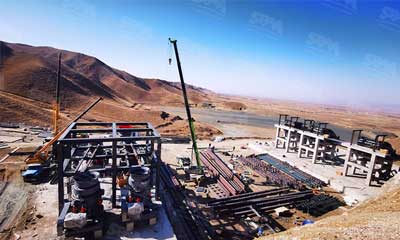
Middle East Copper Oxide Acid Leaching Project
(Leaching—Extraction—Electrolysis)
Key Advantages:
- Low investment cost
- Operation cost is lower than thermometallurgy
- Mainly for low-grade copper ores
- No waste gas or wastewater
- It's easy to get extractants and the price is low.


 Get Solution
 Send Message