



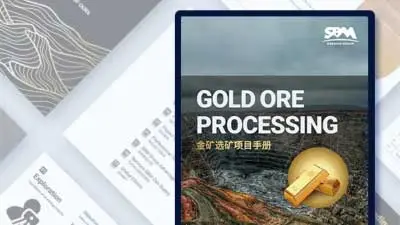

Summary: The core methodology of gold ore beneficiation process design takes ore type as the starting point, unfolding step by step along six stages: "identify type → determine route → design crushing → determine grinding → select separation → plan tailings." The aim is to provide an engineering path that can be followed for gold ore beneficiation process design....
The first step in gold ore beneficiation process design is determining the ore type.
Ore type determines gold occurrence state, associated mineral composition, rock mechanical properties, and target liberation degree — these four factors collectively influence the overall approach to beneficiation process design. For gold ore of the same grade, oxidized ore can be profitable with heap leaching, while relatively refractory sulfide ore requires a complete process flowsheet. The difference in ore type means investment scale may vary several-fold.
This article starts from gold ore types, systematically covers the entire gold ore beneficiation process, focuses on the equipment selection logic in the crushing stage, and unfolds step by step to provide a followable path for gold ore beneficiation process design.

I. Identifying Gold Ore Types
Gold ore types can be classified from three dimensions, each corresponding to different beneficiation strategies.
1. By beneficiation characteristics: easy-to-treat vs. refractory
In terms of difficulty, gold ore is divided into easy-to-treat ore and refractory ore, which directly determines the complexity of the process route:
- Easy-to-treat gold ore: Gold exists in natural form with relatively coarse particles, can achieve single-particle liberation through conventional grinding, and high recovery rates can be obtained through gravity separation or direct cyanide leaching.
- Refractory gold ore: Gold is encapsulated in sulfide lattices such as pyrite and arsenopyrite, or "preg-robbable" by carbonaceous matter. Conventional cyanide leaching recovery rates are low, and pretreatment is required.
2. By degree of oxidation: oxidized ore vs. sulfide ore
By degree of oxidation, gold ore can be divided into two major categories: oxidized ore and sulfide ore. This dimension directly affects crushing equipment selection and grinding energy consumption.
- Oxidized ore: The ore has undergone long-term weathering, with loose structure and low hardness. Oxidized ore typically belongs to easy-to-treat gold ore, suitable for heap leaching or CIL processes.
- Sulfide ore: Gold exists in encapsulated or intergrown form within sulfides, with high hardness and dense texture.

3. By deposit type
Deposit type reflects the metallogenic geological environment. Common gold deposit types include:
| Deposit Type | |
| Orogenic gold (including quartz-vein type, structural altered-rock type) | Intrusion-related type (porphyry type, skarn type) |
| Volcanic hydrothermal gold | Placer gold |
| Carlin-type (fine-disseminated) | Saprolitic gold |
Note: The same deposit type may contain both oxidized and sulfide ore. Actual process design still needs to be determined in conjunction with process mineralogy studies.
4. Mineralogical diagnostic checklist
Before entering the gold ore process route selection, ensure the following information is clear:
- Gold occurrence state
- Main associated mineral composition
- Ore compressive strength and abrasiveness
- Target liberation degree
- Harmful element content
II. Determining the Gold Ore Beneficiation Process Route
After completing ore type diagnosis, the corresponding process route can be selected based on ore type. Gold ore beneficiation process routes can be broadly summarized into four:
1. Oxidized ore heap leaching
Crushing → heap leaching → activated carbon adsorption → desorption electrowinning
Applicable conditions: oxidized ore, low grade, large throughput, site suitable for heap leaching. Low investment, but relatively low recovery rate.
2. Whole-ore cyanidation
Crushing → grinding → CIL (carbon-in-leach) → desorption electrowinning
Applicable conditions: oxidized ore, medium grade, higher recovery rate required.
3. Flotation + concentrate cyanidation
Crushing → grinding → gravity separation + flotation → concentrate cyanidation
Applicable conditions: Gold is intergrown with sulfides but not lattice-encapsulated. Concentrate cyanidation can significantly reduce tailings volume for treatment.
4. Pretreatment + cyanidation
Crushing → grinding → flotation → concentrate pretreatment → cyanide leaching → CIL
Applicable conditions: Gold is lattice-encapsulated by sulfides or preg-robbed by carbonaceous matter. The most complex process with higher investment, but a necessary path for refractory ore.

III. Designing the Gold Ore Beneficiation Crushing Stage
The design of the gold ore beneficiation crushing stage directly affects the efficiency of subsequent grinding and beneficiation and the overall economic value.
1. Determining crushing product size
In the gold ore beneficiation process, the core mission of the crushing stage is to progressively reduce run-of-mine ore from post-blasting large blocks to mill feed particle size, creating suitable feed conditions for grinding (typically P80 = 8–15 mm).
The key principle in determining P80 is "more crushing, less grinding." In the beneficiation energy consumption structure, crushing energy consumption is far lower than grinding energy consumption. This means investing a bit more in the crushing stage can yield a certain degree of energy savings in the grinding stage.
2. Crusher selection
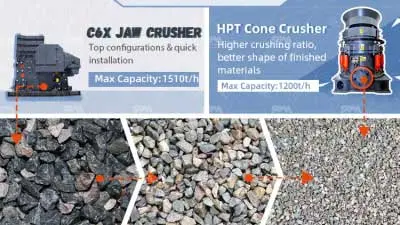
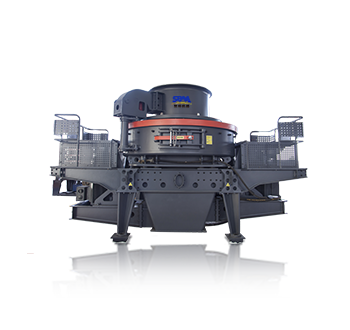
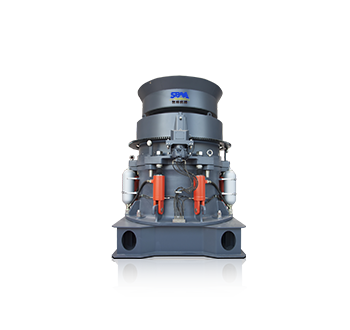
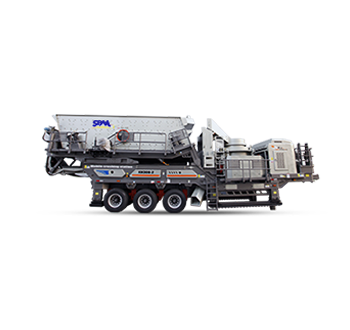
For gold ore crushing, jaw crushers are commonly used in the primary crushing stage, with flexible selection based on capacity. In the secondary crushing stage, impact crushers and cone crushers are common, and the selection logic for this stage needs to be determined based on the mechanical properties of the gold ore.
When can an impact crusher be selected?
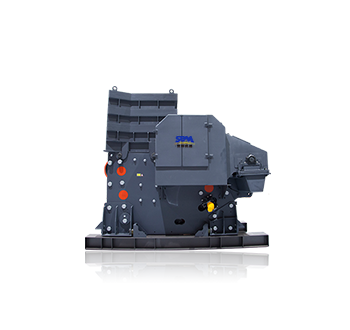
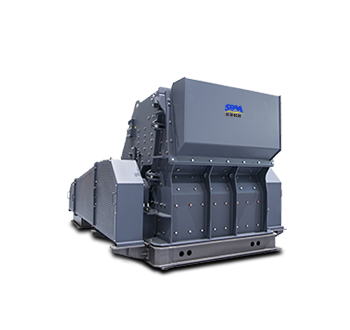
An impact crusher uses blow bars on a high-speed rotating rotor to strike the ore. The ore is thrown against impact liner plates for repeated collision crushing — its essence is impact crushing.
For gold ore below medium hardness (such as some oxidized gold ore), impact crushing can achieve efficient crushing with excellent product particle shape.
Applicable conditions: medium to low hardness ore, low silica content, weak abrasiveness. Typical scenarios: secondary and tertiary crushing of oxidized gold ore and weathered gold ore.
Not applicable conditions: When gold ore has high hardness or high silica content, it causes severe abrasion to impact crusher blow bars and impact liners. The impact crusher also faces the problem of rapid wear part consumption. Impact crushing, when facing high-hardness, high-abrasiveness ore, produces a large amount of impact that cannot achieve effective crushing.

When can a cone crusher be selected?
A cone crusher crushes ore through the eccentric gyratory motion of the mantle, compressing ore between the mantle and concave. Its core principle is inter-particle compression crushing. When a sufficiently dense material layer forms in the crushing chamber, ore particles compress against each other, achieving effective crushing.
The advantage of cone crushers under high-silica hard-rock conditions: compressive stress crushing efficiency is high, favorable for optimizing the particle size distribution of grinding feed; wear is controllable.
Applicable conditions: high hardness ore, high silica content, large throughput conditions. Typical scenarios: secondary and tertiary crushing of quartz-vein gold ore and structural altered-rock gold ore.

IV. Determining Grinding Parameters
The purpose of grinding is to achieve full single-particle liberation of gold while avoiding over-grinding. Different gold ore types have significantly different requirements for grinding fineness, which needs to be set based on ore type.
Grinding fineness is not "the finer the better." Over-grinding not only wastes energy but also leads to increased slimes, reduced flotation selectivity, and ultimately reduced recovery rates. The operational path for determining the economically optimal grinding fineness generally involves the following steps:
- Heavy mineral separation analysis: Take a representative ore sample for heavy mineral separation to observe gold particle size distribution and occurrence state.
- Chemical phase analysis: Determine the distribution ratio of gold in different mineral phases (free gold, sulfide-encapsulated gold, silicate-encapsulated gold, etc.).
- Process mineralogy study: Quantitatively analyze gold liberation degree at different grinding fineness levels.
- Plot liberation curve: With grinding fineness on the horizontal axis and gold liberation degree on the vertical axis, find the inflection point where liberation growth levels off.
- Economic comparison: Compare the incremental grinding energy consumption (cost) with the recovery rate improvement (revenue) to determine the optimal fineness.
V. Selecting Separation Process
Common gold ore separation processes include gravity separation, flotation, cyanide leaching, and other processes. The selection of separation process follows one core principle: gold occurrence state is the core basis for separation method selection, but the final solution must be determined by comprehensively considering gold particle size distribution, associated mineral composition, ore grade, and other multiple factors.
1. When to use gravity separation?
Applicable conditions: Ore contains coarse free gold.
Gravity separation utilizes gold's density advantage for separation. It is commonly used as a bypass operation in the grinding circuit to recover coarse gold in advance, reducing the load on subsequent cyanide leaching.
2. When to use flotation?
Applicable conditions: Gold is closely intergrown with sulfides (whether easy-to-treat or refractory), and the associated mineral composition allows effective enrichment through flotation.
Flotation adjusts collectors and frothers to attach gold-bearing sulfides to air bubbles for flotation. For ore where gold exists as inclusions, flotation produces gold-bearing sulfide concentrate, which then undergoes subsequent treatment.
Key judgment: If gold is closely intergrown with sulfides, flotation can achieve a high recovery rate; if some gold exists in free form, gravity separation needs to be added before or within the flotation circuit to avoid free gold loss to tailings.
3. When to use cyanide leaching?
Applicable conditions: Gold has been liberated or exposed (free gold, oxidized ore).
Cyanide leaching is the core process in gold ore beneficiation. Leaching efficiency depends on:
- Degree of gold liberation
- Cyanide concentration
- pH value
- Dissolved oxygen level
4. CIP vs. CIL — how to choose?
Carbon-in-pulp (CIP) and carbon-in-leach (CIL) are the most widely applied gold extraction processes for oxidized ore and easy-to-treat gold ore, combining cyanide leaching with activated carbon adsorption.
- CIP: Leaching first, then adsorption; leaching and adsorption are conducted in separate stages. Selection basis: ores with fast leaching rates (most oxidized ore).
- CIL: Leaching and adsorption occur simultaneously; the flowsheet is more compact. Selection basis: ores with slow leaching rates; simultaneous adsorption reduces dissolved gold retention in the circuit.
Both are based on the high adsorption capacity of activated carbon for gold cyanide complex [Au(CN)₂]⁻. Loaded carbon undergoes desorption followed by electrowinning for gold recovery.
VI. Planning Tailings Solution
The tailings solution is not a "wrap-up" at the end of the process chain, but a front-end constraint during the design stage. Ore type determines the types of harmful elements and potential environmental risks in tailings, which in turn determines the technical route for tailings treatment.
The tailings disposal method itself needs to be determined at the design stage. Traditional wet tailings impoundments carry dam failure risks and leachate management pressures, while filtered dry stacking (dry stack) offers clear advantages in safety and water recovery rate, particularly suitable for water-scarce regions and mining areas with strict environmental requirements. The introduction of the Global Industry Standard on Tailings Management (GISTM) in recent years has further driven the application of dry stacking technology. For high-water-consumption whole-ore cyanidation processes, dry discharge can significantly improve water recovery rates and reduce fresh water consumption.

Conclusion
Gold ore beneficiation process design has no fixed standard template, but investors need a clear design path:
Identify ore type → Determine process route → Design crushing stage → Determine grinding parameters → Select separation process → Plan tailings solution
Starting from ore type and completing each stage's design step by step, the final result is an optimal solution tailored to the specific type of gold ore.
SBM has been deeply engaged in the metal ore crushing field for over thirty years, providing professional customized process solutions for global gold ore projects. If you have related business needs, please contact us.


 Get Solution
 Send Message