




Summary: Vibrating screen is an indispensable and important equipment in mines, chemical plants and cement plants. ...
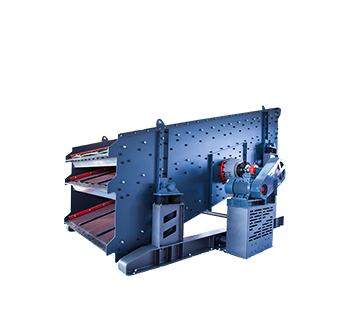
Vibrating screen is an indispensable and important equipment in mines, chemical plants and cement plants. Its screening efficiency directly affects the production efficiency. We have prepared the following guide to help you improve the efficiency of the vibrating screen.


1. Use a large size sieve
The use of large-size sieves increases the vibration force and amplitude, increases the impact stress and shear stress of the sieve plate on the material, overcomes the adhesion between ore particles, reduces the clogging of the screen surface, and makes the screened materials loose quickly, stratification and sieving. Due to the improvement of the operating conditions of the screen, the screening efficiency of the vibrating screen is effectively improved.
2. Increase the screening area in the vibrating screen
Reducing the material amount per unit screen surface can improve the screening efficiency. When the actual material amount on the screen surface is about 80% of the screen capacity, the screening efficiency of the screen is high. Due to the large number of screened fine particles, it is necessary to ensure sufficient screening area during screening, and appropriately lengthen the screen surface of the vibrating screen to make the aspect ratio above 2:1, which can effectively improve the screening efficiency.
3. Use a reasonable inclination angle to control the flow speed of the material
Generally speaking, the larger the inclination angle of the vibrating screen is, the faster the material on the screen moves, the larger the production capacity and the lower the efficiency. Therefore, in order to improve the screening efficiency of the equipment, the moving speed of the material on the screen surface can be controlled below 0.6m/s, and the left and right inclination of the screen surface can be maintained at about 15°.
4. Equal thickness screening method is adopted
As the screening process proceeds, the material bed thickness on the screen surface gradually decreases from the feed end to the discharge end, leading to an unreasonable distribution of material load. In other words, the screen surface is overloaded at the beginning and underutilized later on.
Therefore, a broken-line screen surface with different inclinations can be used to control the material moving speed at each section, so that the ore stream flows forward obliquely, thereby improving the penetration of difficult-to-screen particles at the discharge end.
5. Adopt multi-layer screen
Almost all difficult-to-screen particles and blinded particles in the feed of ordinary single-layer screens move from the feed end to the discharge end, thus affecting the stratification and screening of medium and fine materials. A multi-layer screen is adopted, with screen mesh size gradually increasing from the lower layer to the upper layer, and the inclination angle of the screen surface gradually decreasing.
In other words, materials with different particle sizes can be loosened, layered, pre screened and fine screened on the upper, middle and lower screen surfaces with different inclination angles and screen holes, so as to overcome screen hole blockage and improve screening efficiency.
The above introduces 5 methods to improve the screening rate of vibrating screen. In sand and gravel production, if the screening efficiency of vibrating screen is low, the above 5 methods can be adopted to improve the screening efficiency of vibrating screen.


 Get Solution
 Send Message